
How to Prepare Your Soil for a Productive Kharif Season
May
Introduction: Improve Soil Health Pakistan Kharif
The health of your soil before you plant is one of the strongest predictors of your final harvest. Many Pakistani farmers apply fertilizers at planting without ever assessing the actual condition of their soil — and then wonder why their yields fall short.
With the Kharif season approaching, now is the right time to take a few simple but powerful steps to get your soil ready for rice, maize, cotton, sugarcane, and other summer crops.
Step 1 — Conduct a Basic Soil Assessment
Before you apply anything, observe your field. Signs of poor soil health include: hard, crusted topsoil after rain, waterlogging in low spots, pale or yellowing seedlings, and slow decomposition of crop residues. These are your soil sending you signals.
If possible, do a basic soil test through your local agriculture department or private lab. A soil test tells you your pH level, organic matter content, and which nutrients are deficient. This takes the guesswork out of your input program.
Step 2 — Improve Soil Structure with Organic Matter
Continuous cropping and chemical-only farming depletes organic matter in Pakistani soils. Low organic matter means poor water retention, weak soil structure, and reduced fertilizer efficiency.
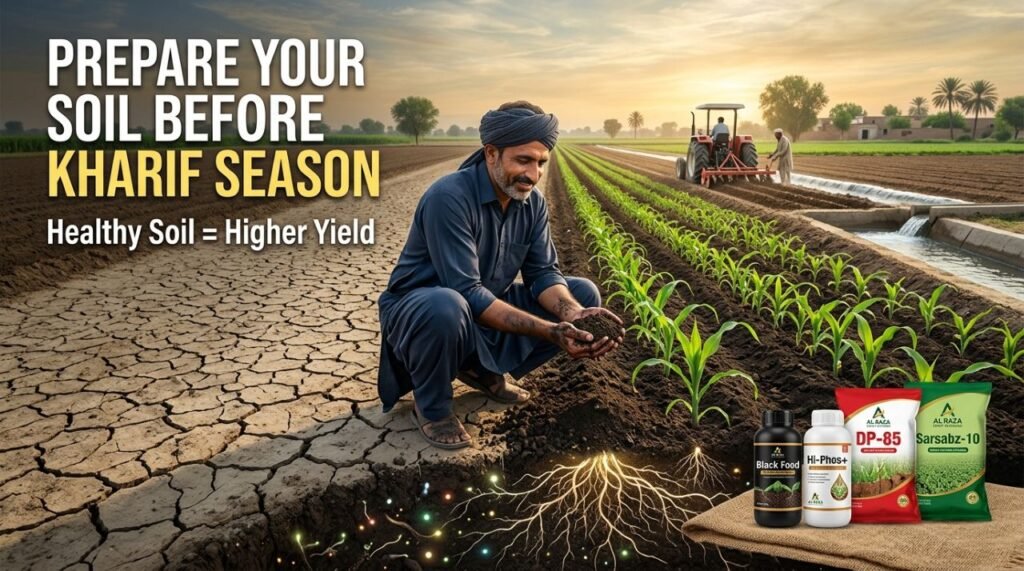
Apply Black Food (organic soil conditioner) before land preparation to restore organic matter, improve microbial activity, and create better physical conditions for roots. Black Food is especially recommended for soils that feel compacted or do not absorb water well.
Step 3 — Address Phosphorus and Root Development
Phosphorus availability drops significantly in calcareous soils — which cover much of Pakistan’s agricultural land. Poor phosphorus means weak roots, slow early growth, and vulnerable seedlings.
Apply Hi-Phos+ or DP-85 at land preparation to make phosphorus readily available from day one of the crop. These products use advanced phosphorus chemistry to maximize uptake efficiency even in high-pH soils.
Step 4 — Replenish Depleted Micronutrients
Years of repeated cropping remove trace elements from the soil faster than they are replaced. Zinc, boron, and manganese deficiencies are extremely common in Kharif crop fields.
Incorporate Sarsabz-10 at transplanting or early growth to provide a full spectrum of 10 chelated micronutrients right when the crop needs them most.
Step 5 — Plan Your Fertilizer Program in Advance
Do not wait until the crop shows deficiency symptoms to act. By then, yield potential is already lost. Plan your complete nutrition schedule — from basal application to top dressing to foliar sprays — before sowing. This saves money, reduces waste, and produces measurably better results.
Conclusion
Healthy soil is the foundation of a profitable Kharif season. By investing a little time and the right inputs before planting, you can dramatically improve what your crop gives back at harvest. Our agri experts at Al Raza Crop Sciences are available to help you build a customized soil preparation plan for your fields. Call or WhatsApp: 0321-3768873.